|
As this forum is rarely used anymore, we've locked it. Feel free to browse and read. Questions? Please reach out to us directly. Cheers! |

|
 |
|
|
| Author |
Message |
jeffslife

Joined: 17 Apr 2010
Posts: 4190
Location: ohio usa
|
| Posted: Wed Feb 20, 2013 6:25 am Post subject: Bi wire ? |
|
|
OK so I am hooking up a new center and surrounds and I have the option to remove the connectors and either Bi amp them or Bi wire them. So Bi amp I get that that, have been doing it forever in car audio, makes perfect sense you get control over the whole FR range. But Bi wire ? I dont get it. The manual says you will be able to hear a subtle difference. What I see is dropping the speaker to 4 ohms. I dont see why it wouldnt already be in 4 ohms with the connectors in place. I dont know what I am missing here. The connectors are in parallel not series. Im confused.
_________________
We are ALL job creators !
|
|
| Back to top |
|
 |
Tom.W

Joined: 09 Mar 2006
Posts: 6635
|
| Posted: Wed Feb 20, 2013 7:36 am Post subject: |
|
|
|
I think the idea is to bridge the drivers at the amp instead of at the speaker. Less cable resistance over two pair ? I doubt you could hear a difference though...
|
|
| Back to top |
|
|
kal
Forum Administrator

Joined: 06 Mar 2006
Posts: 18114
Location: Ottawa, Canada
TV/Projector: JVC DLA-NZ7
|
| Posted: Wed Feb 20, 2013 2:08 pm Post subject: |
|
|
See: http://en.wikipedia.org/wiki/Bi-wiring
| Quote: | 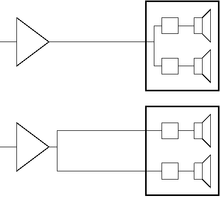
Amplifier and loudspeaker with two elements and crossover networks. Top: normal connection. Bottom: bi-wiring.

Bi-wiring is a means of connecting a loudspeaker to an audio amplifier, primarily used in hi-fi systems. Normally, there is one pair of connectors on a loudspeaker and a single cable (two conductors) runs from the amplifier output to the terminals at the loudspeaker housing. From this point, connections are made to the loudspeaker drivers — most often through crossover networks. In bi-wiring, each loudspeaker has two pairs of connectors and two cables are run from the amplifier output to the speaker cabinet — one for the high frequency or tweeter driver and one for the low frequency driver (through two separate crossover networks). The purported advantage of this is that there is less interaction between high and low frequency signals.
It is overlooked that both ways (connecting the two drivers at either the amplifier's end, or internally the speaker cabinet) of making speaker connections are electrically equivalent. This has led some to sarcastically refer to the practice as "buy-wiring", implying it is nothing more than a marketing gimmick for expensive speaker wire.[1]
However, there are many people in the hi-fi community[who?] who fully accept that bi-wiring brings an audible improvement over standard single cabling[citation needed]. Bi-wiring should not be confused with the hi-fi practice of bi-amping, which brings a true separation of signal frequencies. |
I bi-wire do it myself, just because I can and because the cost difference was negligible. I do like the term "buy-wire" though.  With the cost of some of the esoteric speaker wire out there it would get expensive very fast. I use Home Depot 12ga in-wall rated stuff. With the cost of some of the esoteric speaker wire out there it would get expensive very fast. I use Home Depot 12ga in-wall rated stuff.
I've never done any critical A/B comparisons but I don't think it makes any difference on my setup that is noticeable.
I could put the jumpers in place at the speaker end and turn the two 12 ga wires into one fat ~8 ga wire. That would probably have the same amount of benefits (ie: marginal at best).
Kal
_________________

Support our site by using our affiliate links. We thank you!
My basement/HT/bar/brewery build 2.0
|
|
| Back to top |
|
|
dturco

Joined: 06 Feb 2009
Posts: 3778
Location: Eastern Shore Maryland
TV/Projector: Runco DLP VX-3000i Marquee 9500 parts doner
|
| Posted: Wed Feb 20, 2013 2:46 pm Post subject: |
|
|
Jeff, all bi-wiring does is allow the use of more speaker cable to be at the speaker, which you've already done. Whether its as one big run of copper, or 2-3 smaller runs, the benefit is just more signal can get through.
There's a debate in bi-wiring circles about using "better" grade wire on the highs and mids and the "lesser" grade, size, whatever, on the woofers. The argument is it will improve the sound at the frequencies we humans hear the most detail at, were the human voice frequency is at.
I posit it make zero difference, copper is copper. The sound improvement as I stated in one of your other threads, is just it allows the signal to get there with as little resistance as possible.
For more fun there are those who Bi-wire the Tweeters and Midranges with silver wire and the woofers with cooper to make the upper frequencies shimmer....
I don't buy that either. Copper, lots of it, works at the least amount of cost given the circumstances.
Could it work? Silver make a difference? Hell if I know, the cost to performance ratio is way out of line for me; plus as I age [you too] we lose upper frequency hearing, sounds like [pun intended] a losing {ha} proposition to your wallet to go along with the hearing loss too.
Did that clear it up, or just add more sh*t to think about?
_________________
Firefly rules. Can't stop the signal.
http://www.hulu.com/firefly
|
|
| Back to top |
|
|
jeffslife
Joined: 17 Apr 2010
Posts: 4190
Location: ohio usa
|
| Posted: Wed Feb 20, 2013 2:59 pm Post subject: |
|
|
I like the way it sounds now and I am basically running 8 gauge to the speakers so I think I will just let it go for now maybe I will bi amp them at a later date.
_________________
We are ALL job creators !
|
|
| Back to top |
|
|
kal
Forum Administrator
Joined: 06 Mar 2006
Posts: 18114
Location: Ottawa, Canada
TV/Projector: JVC DLA-NZ7
|
| Posted: Wed Feb 20, 2013 3:07 pm Post subject: |
|
|
Bi-amping is certainly something that can make a difference. I'd be careful doing it however, meaning that unless you're running good quality separate amps in the first place I wouldn't bother. More doesn't mean better if the equipment is so-so to begin with. Better to have less but better quality stuff to begin with (IMHO).
I actually see this a lot with speakers too: People wanting to put together 7.1, or even 9.1 setups with what amounts to cheaper/crappier speakers. More is better right? Nope. I'd rather have a 5.1 setup with better speakers than 9.1 with crappier speakers.
Kal
_________________
Support our site by using our affiliate links. We thank you!
My basement/HT/bar/brewery build 2.0
|
|
| Back to top |
|
|
Jeremy112

Joined: 28 Sep 2006
Posts: 2649
Location: Fond du Lac, WI
|
| Posted: Wed Feb 20, 2013 4:52 pm Post subject: |
|
|
| kal wrote: | Bi-amping is certainly something that can make a difference. I'd be careful doing it however, meaning that unless you're running good quality separate amps in the first place I wouldn't bother. More doesn't mean better if the equipment is so-so to begin with. Better to have less but better quality stuff to begin with (IMHO).
I actually see this a lot with speakers too: People wanting to put together 7.1, or even 9.1 setups with what amounts to cheaper/crappier speakers. More is better right? Nope. I'd rather have a 5.1 setup with better speakers than 9.1 with crappier speakers.
Kal |
I agree completely kal, thats why I'm still rockin' the 5.1 setup  besides, if I used more than 5.1 it would go to waste anyway since I would probably only use it in my receivers "9 channel stereo" mode, and even then, I prefer listening to my music from the front speakers only. Besides, unless you have a HUGE room, 9.1 wouldn't be very effective. And even now I dont think they have 10 channel movies.... (not sure on that though, someone somewhere is plotting total world domination, that I do know! besides, if I used more than 5.1 it would go to waste anyway since I would probably only use it in my receivers "9 channel stereo" mode, and even then, I prefer listening to my music from the front speakers only. Besides, unless you have a HUGE room, 9.1 wouldn't be very effective. And even now I dont think they have 10 channel movies.... (not sure on that though, someone somewhere is plotting total world domination, that I do know!  ) )
_________________
When I'm asking for a Model number, that doesn't mean I'm asking for a nude photo with your number on it
|
|
| Back to top |
|
|
draganm

Joined: 08 Mar 2006
Posts: 8990
Location: Colorado
|
| Posted: Wed Feb 20, 2013 6:54 pm Post subject: |
|
|
I bi-wired my Quad 22L full range speakers but later undid it and went back to a single wire and brass bridging straps.
The quads are a very forward sounding, high detailed and rather "bright" sounding speaker. Bi-wiring made this even more exaggerated, it was an obvious and unpleasant change. I think what's happening is your changing the impedance to the second set of drivers. Typically, you wire to the lower posts and the brass straps carry the signal up to the tweeter and or mid-range driver. Those straps can have significant impedance to them.
Actually, what I finally did was replace the straps with Resistors to roll off the top even more.
So i think it depends on how your speakers are voiced. A speaker that's too laid back and maybe a little muddy might benefit, but this characteristic is rather rare in today's loud-speakers.
|
|
| Back to top |
|
|
jeffslife
Joined: 17 Apr 2010
Posts: 4190
Location: ohio usa
|
| Posted: Wed Feb 20, 2013 7:52 pm Post subject: |
|
|
I never even considered the impedance of those straps.
_________________
We are ALL job creators !
|
|
| Back to top |
|
|
Curt Palme
CRT Tech
Joined: 08 Mar 2006
Posts: 24396
Location: Langley, BC
TV/Projector: All of them!
|
| Posted: Wed Feb 20, 2013 8:19 pm Post subject: |
|
|
| draganm wrote: | I bi-wired my Quad 22L full range speakers but later undid it and went back to a single wire and brass bridging straps.
The quads are a very forward sounding, high detailed and rather "bright" sounding speaker.
Those straps can have significant impedance to them.
. |
Whoa, a couple of things here.
a) This is where some audiophiles and I deviate. I can understand a 'bright' sounding speaker. I can't understand 'forward' or 'laid back', 'focused speaker' etc.
Yes, I hated creative writing, but spell speaker performance or sound out only by referencing the audio frequency spectrum. Please.
A 'laid back' speaker to me is lying in a chaise lounge somewhere, probably in Jamaica, smoking a spliff. 
b)As for relatively thick straps having a significant amount of impedance? I beg to differ on this one! They aren't twisted around each other, they are separated by inches, and are as I said, relatively thick. Virtually no impedance as a result in my books. IN fact, I'd argue that a whole lot of esoteric speaker wires have a whackload of impedance to them, and locally one high end guy kept taking out his tweeters on a regular basis. He didn't want my help, so he flew out Ken Hotte of GooSystems fame. After the local high end stereo place replaced about 6 tweeters, Ken (correctly) diagnosed that his esoteric speaker wire was ridiculously capacitive, causing his audiofool amp to oscillate, and fry the tweeters. True story!
Some $.25/ft Home Depot speaker wire permanently cured his issues.. which is what I had suggested as well.
|
|
| Back to top |
|
|
draganm
Joined: 08 Mar 2006
Posts: 8990
Location: Colorado
|
| Posted: Tue Feb 26, 2013 5:29 pm Post subject: |
|
|
| Curt Palme wrote: | | b)As for relatively thick straps having a significant amount of impedance? I beg to differ on this one! They aren't twisted around each other, they are separated by inches, and are as I said, relatively thick. Virtually no impedance as a result in my books. . |
Curt I'm not going to argue the electrical detail. Something about the sound changed dramatically when bi-wiring.
Maybe it's impedance, resistance, phase accuracy, whatever, but the sound changed.
AFA bright or laid back, I think we all know your not an audiophile, so if all speakers sound the same to you then .............
|
|
| Back to top |
|
|
|
|
|
|
|
You cannot post new topics in this forum
You cannot reply to topics in this forum
You cannot edit your posts in this forum
You cannot delete your posts in this forum
You cannot vote in polls in this forum
You cannot attach files in this forum
You can download files in this forum
|
Forum powered by phpBB © phpBB Group
|
|