| Author |
Message |
mr_ro_co

Joined: 08 May 2006
Posts: 1643
Location: Santa Fe NM
|
| Posted: Tue Oct 04, 2011 7:16 pm Post subject: What is the Marquee C element made of? |
|
|
Acrylic or Polycarbonate?
Those of us who are using the new glycerin based coolant need a definitive answer. It's important!
Steve
_________________
Not only is there no god, try finding a plumber on Sunday!
|
|
| Back to top |
|
 |
zGman
Joined: 22 May 2006
Posts: 599
|
| Posted: Tue Oct 04, 2011 7:47 pm Post subject: |
|
|
My information was that it is acrylic - that is the material used in the rest of the lens.
(Disclaimer- -but if your life depends on it then better find out for yourself...!)
G
|
|
| Back to top |
|
|
draganm

Joined: 08 Mar 2006
Posts: 8990
Location: Colorado
|
| Posted: Tue Oct 04, 2011 9:07 pm Post subject: Re: What is the Marquee C element made of? |
|
|
| mr_ro_co wrote: | Acrylic or Polycarbonate?
Those of us who are using the new glycerin based coolant need a definitive answer. It's important!
Steve |
umm, this sounds ominous. What's the wrong answer? 
|
|
| Back to top |
|
|
mr_ro_co
Joined: 08 May 2006
Posts: 1643
Location: Santa Fe NM
|
| Posted: Tue Oct 04, 2011 9:20 pm Post subject: Re: What is the Marquee C element made of? |
|
|
| draganm wrote: | | mr_ro_co wrote: | Acrylic or Polycarbonate?
Those of us who are using the new glycerin based coolant need a definitive answer. It's important!
Steve |
umm, this sounds ominous. What's the wrong answer? |
Acrylic is the wrong answer. It is NOT compatible with glycerin, which is what the Orison coolant is based on.
Steve
_________________
Not only is there no god, try finding a plumber on Sunday!
|
|
| Back to top |
|
|
dvh99

Joined: 25 Dec 2009
Posts: 2158
Location: nederland
|
| Posted: Tue Oct 04, 2011 10:15 pm Post subject: |
|
|
is this a guessing contest?
how about fluorite.
some light reading  . .
http://en.wikipedia.org/wiki/Abbe_number
_________________
1 answer always poses multiple questions.
marquee 9500ultra HD10L moome hdmi1.3 v3+ some mods.
|
|
| Back to top |
|
|
dvh99
Joined: 25 Dec 2009
Posts: 2158
Location: nederland
|
| Posted: Tue Oct 04, 2011 10:23 pm Post subject: |
|
|
for what it is worth, i mailed 3m and asked them.
expect 2 days for an answer, so they told me.
_________________
1 answer always poses multiple questions.
marquee 9500ultra HD10L moome hdmi1.3 v3+ some mods.
|
|
| Back to top |
|
|
mr_ro_co
Joined: 08 May 2006
Posts: 1643
Location: Santa Fe NM
|
| Posted: Tue Oct 04, 2011 11:16 pm Post subject: |
|
|
| dvh99 wrote: | for what it is worth, i mailed 3m and asked them.
expect 2 days for an answer, so they told me. |
Thanks! Someone should know. I think I kept the clam shell packaging for one of mine and it might say on the label.
Steve
_________________
Not only is there no god, try finding a plumber on Sunday!
|
|
| Back to top |
|
|
zGman
Joined: 22 May 2006
Posts: 599
|
| Posted: Wed Oct 05, 2011 12:46 am Post subject: |
|
|
Index of refraction of polycarbonate seems too high at 1.586...
I am betting on acrylic
G
|
|
| Back to top |
|
|
mr_ro_co
Joined: 08 May 2006
Posts: 1643
Location: Santa Fe NM
|
| Posted: Wed Oct 05, 2011 2:58 am Post subject: |
|
|
| zGman wrote: | Index of refraction of polycarbonate seems too high at 1.586...
I am betting on acrylic
G |
I'm pretty sure it's acrylic, but need to verify. Unfortunately, it's not compatible with the new glycerin based coolant.
Curt? Tim? Mike? Athanasios? Surely you guys know what the C-element is made of.
Steve
_________________
Not only is there no god, try finding a plumber on Sunday!
|
|
| Back to top |
|
|
nidi
Joined: 17 Aug 2008
Posts: 305
Location: Switzerland
|
| Posted: Wed Oct 05, 2011 12:06 pm Post subject: Re: What is the Marquee C element made of? |
|
|
| mr_ro_co wrote: | | draganm wrote: | | mr_ro_co wrote: | Acrylic or Polycarbonate?
Those of us who are using the new glycerin based coolant need a definitive answer. It's important!
Steve |
umm, this sounds ominous. What's the wrong answer? |
Acrylic is the wrong answer. It is NOT compatible with glycerin, which is what the Orison coolant is based on.
Steve |
do you have a spare one that you don't have to use, like a clear one?
put a flame at the edge , burn a bit and smell the gases.
what does it smell like?
here's a link:
http://www.boedeker.com/burntest.htm
Michael
|
|
| Back to top |
|
|
HaydnG90

Joined: 22 May 2006
Posts: 1356
|
| Posted: Wed Oct 05, 2011 1:32 pm Post subject: |
|
|
|
VDC must know the answer. My money's on acrylic for the reason Galen gave. Plus optical grade PC is a more expensive and is often used as a substitute for acrylic in high impact applications, which is clearly not the case here.
|
|
| Back to top |
|
|
nidi
Joined: 17 Aug 2008
Posts: 305
Location: Switzerland
|
| Posted: Wed Oct 05, 2011 2:25 pm Post subject: |
|
|
| HaydnG90 wrote: | | VDC must know the answer. My money's on acrylic for the reason Galen gave. Plus optical grade PC is a more expensive and is often used as a substitute for acrylic in high impact applications, which is clearly not the case here. |
well, they cost alot, so money would be no issue there.
plastic parts in this size do not cost more than $20 to produce.
try the burn test and smell it, then we know what it is.
Michael
or find out what plastic polymers 3M produces then we know it
transparent plastics:
PC Polycarbonate Lexan (GE) , Makrolon (Bayer)
PMMA Polymethylacrylate Plexiglas (Evonik)
PA12 Polyamide (Grilamid TR-55) (EMS)
Polyester
PSU Polysulfon (Udel)
PPA Polyphtalamide
COC Cyclo Polyolefine Co-Polymer Topas (Celanese Ticona)
|
|
| Back to top |
|
|
HaydnG90
Joined: 22 May 2006
Posts: 1356
|
| Posted: Wed Oct 05, 2011 3:51 pm Post subject: |
|
|
|
Regular plastic maybe but optical quality material I would say is more expensive. Eyeglass lenses in PC are almost 2x the price of regular plastic, which I assume is acrylic or something similar.
|
|
| Back to top |
|
|
nidi
Joined: 17 Aug 2008
Posts: 305
Location: Switzerland
|
| Posted: Wed Oct 05, 2011 4:10 pm Post subject: |
|
|
| HaydnG90 wrote: | | Regular plastic maybe but optical quality material I would say is more expensive. Eyeglass lenses in PC are almost 2x the price of regular plastic, which I assume is acrylic or something similar. |
yes, but how much did 3M charge for a C-Element $60 , $80 ??
and the weight of the element is 163 grams with the black ring.
so, It doesn't really matter how much the plastic costs, when you charge $50 and more for the element
Michael
|
|
| Back to top |
|
|
nidi
Joined: 17 Aug 2008
Posts: 305
Location: Switzerland
|
| Posted: Wed Oct 05, 2011 4:14 pm Post subject: |
|
|
| HaydnG90 wrote: | | Regular plastic maybe but optical quality material I would say is more expensive. Eyeglass lenses in PC are almost 2x the price of regular plastic, which I assume is acrylic or something similar. |
my company , who manufactured the moulds for the injection moulding of DVD,DVD-R, BluRay
got the optical grade PC for less than $4 a kilo , and in the best days we used more than 200 kilos a day
just for testing of the moulds.
Michael
|
|
| Back to top |
|
|
draganm
Joined: 08 Mar 2006
Posts: 8990
Location: Colorado
|
| Posted: Wed Oct 05, 2011 4:51 pm Post subject: Re: What is the Marquee C element made of? |
|
|
| mr_ro_co wrote: | Acrylic is the wrong answer. It is NOT compatible with glycerin, which is what the Orison coolant is based on.
Steve |
Considering MP has had this in his machine for 2 years I'm not worried about it. This happened at the fill line of a leaky original tube with CRT coolant in it so the Orlson stuff can't possibly be worse than.

|
|
| Back to top |
|
|
mr_ro_co
Joined: 08 May 2006
Posts: 1643
Location: Santa Fe NM
|
| Posted: Thu Oct 06, 2011 2:30 pm Post subject: Re: What is the Marquee C element made of? |
|
|
| draganm wrote: | | mr_ro_co wrote: | Acrylic is the wrong answer. It is NOT compatible with glycerin, which is what the Orison coolant is based on.
Steve |
Considering MP has had this in his machine for 2 years I'm not worried about it. This happened at the fill line of a leaky original tube with CRT coolant in it so the Orlson stuff can't possibly be worse than. |
I am worried about it because you can't get red C-elements anymore and they are rare. And I'd rather not have one crack one day and start leaking and make a big mess. Or have one start becoming cloudy. Just because Mike's had it in his machine for two years and nothing bad has happened yet doesn't mean much in the context of plastic degradation. I could bury an underground cooling tower line made from PVC and run propylene gylcol in it for two years and nothing would happen either. Many plastic degradation/embrittlment problems due to a chemical incompatibility with a working fluid take years to fully manifest themselves.
The guy at Orison who is responsible for establishing the compliance of their product with ASTM standards was also concerned. When he asked what all the materials that the fluid was coming in contact with were made and I got to the C-element, telling him I was pretty sure it was made from acrylic, he said "that's a problem." He said acrylic is not compatible with glycerin. So if the C-element is made from acrylic we probably shoudn't be using this stuff.
I do not know what the compatibility is between ethylene glycol and acrylic. Maybe Tim or Curt could chime in on what they've seen as far as longevity of C-elements in the field.
The stuff I've found on the web indicates there is no chemical incompatibility problem between acrylic and glycerin, so maybe the Orison guy is wrong.
http://www.keyinstruments.com/technical-support/chemical-compatibility-charts/acrylic
Best,
Steve
_________________
Not only is there no god, try finding a plumber on Sunday!
|
|
| Back to top |
|
|
HaydnG90
Joined: 22 May 2006
Posts: 1356
|
| Posted: Thu Oct 06, 2011 2:36 pm Post subject: |
|
|
Maybe I missed the thread but why are people people substituting glycerin for the usual material, glycol?
From what I can see in the literature both glycol and glycerin(glycerol) are compatible with clear acrylic plastic
http://microadvances.com/chemicals1.htm
I would be looking elsewhere for the source of this problem. Maybe there's an additive in this product that reacts with the aluminum or plastic. If the fluid was attacking the C-element there would certainly be evidence such as pitting or crazing. That crud is coming from somewhere. Wipe down the c-element and check for surface changes.
|
|
| Back to top |
|
|
Tom.W

Joined: 09 Mar 2006
Posts: 6635
|
| Posted: Thu Oct 06, 2011 4:17 pm Post subject: |
|
|
The usual mix is 70% glycol to 30% glycerin. I was thinking the c elements were made of polycarbonate but it's not clear enough and normally has a slight green tint.
http://www.boedeker.com/polyc_p.htm
|
|
| Back to top |
|
|
draganm
Joined: 08 Mar 2006
Posts: 8990
Location: Colorado
|
| Posted: Thu Oct 06, 2011 4:41 pm Post subject: |
|
|
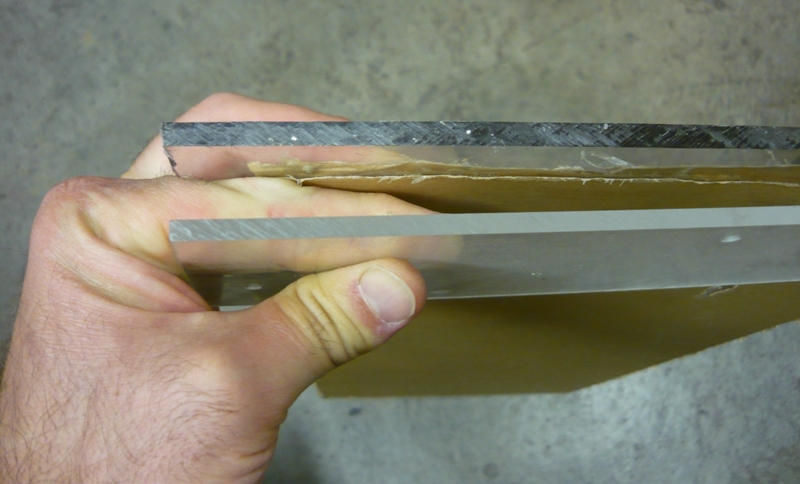
I work with both Polycarb and Polyacrolate (acrylic) . PolyC. has a bluish/purple tint to it when you look at the material on-edge. IF you take the clear c-element and look at the side of the mounting flangle you'll see it.
PolyA. has a Gray or (if it's old) yellowish tint and is much more brittle than PolyC. It also has a tendency to exhibit crazing when exposed to alchohol or even water depending on how it was manufactured. The extruded stuff is the worst.
I highly doubt they used PolyA in the C-element, it would have been a disaster me thinks in the long run.
| Description: |
|
| Filesize: |
223.98 KB |
| Viewed: |
8187 Time(s) |
|
|
|
| Back to top |
|
|
|
|