| Author |
Message |
Spanky Ham

Joined: 22 Mar 2006
Posts: 5643
Location: Comedy Central
|
| Posted: Thu Oct 07, 2010 4:05 am Post subject: Tinting Glycol for LC pjs |
|
|
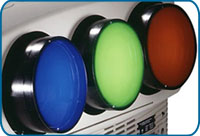
I was thinking (I know that can be dangerous) recently when looking at my 909s with clear C-elements that there must be a good way to get Rec709 out of them. I saw Craig's test that he did with the red element. I think he also tested the green element. Since colored c-elements are no longer available, I was thinking that maybe using colored glycol might be an alternative. Furthermore with the ability to change the color more easily, it shouldn't be difficult to get REC709. Any thoughts?
https://www.curtpalme.com/forum_archived/viewtopic.php@t=13984.html
http://www.curtpalme.com/Tinting_Glycol1.shtm
|
|
| Back to top |
|
 |
ecrabb
Forum Moderator

Joined: 13 Mar 2006
Posts: 15909
Location: Utah
TV/Projector: JVC RS40, Epson 5010
|
| Posted: Thu Oct 07, 2010 4:09 am Post subject: |
|
|
You can't do that, Spanky... The magnitude of color filtering would change with the volume of tinted glycol, from thinner/lighter in the center to thicker/darker at the edge of the lens.
SC
|
|
| Back to top |
|
|
garyfritz

Joined: 08 Apr 2006
Posts: 12088
Location: Fort Collins, CO
|
| Posted: Thu Oct 07, 2010 4:20 am Post subject: |
|
|
|
I wonder if there's some way to dye the C-element itself?
|
|
| Back to top |
|
|
AnalogRocks
Forum Moderator
Joined: 08 Mar 2006
Posts: 26706
Location: Toronto, Ontario, Canada
TV/Projector: Sony 1252Q, AMPRO 4000G
|
| Posted: Thu Oct 07, 2010 4:22 am Post subject: |
|
|
window tint film
_________________
Tech support for nothing
CRT.
HD done right!
|
|
| Back to top |
|
|
Spanky Ham
Joined: 22 Mar 2006
Posts: 5643
Location: Comedy Central
|
| Posted: Thu Oct 07, 2010 4:25 am Post subject: |
|
|
| ecrabb wrote: | You can't do that, Spanky... The magnitude of color filtering would change with the volume of tinted glycol, from thinner/lighter in the center to thicker/darker at the edge of the lens.
SC |
Yeah it is late. I didn't think of that.
|
|
| Back to top |
|
|
stefuel
Joined: 07 Mar 2006
Posts: 3353
Location: Green Harbor MA USA
|
| Posted: Sat Oct 09, 2010 10:27 am Post subject: |
|
|
I tried to dye a c-element once and it did not work well. I have had luck with other plastics though.
If you were really carefull and clean, I bet you could sandwich in some photographic gel filter within a lens pack inside a HD-10 lens.
Taking a lens apart is not that hard. What really sucks is getting them back together without any dust particles showing.
I did three lenses once that had gotten wet and had fogged up inside. It took me a whole day.
_________________
Chip
A Barco is only a AmPro with training wheels
Card carrying member of the AVS chain gang.
|
|
| Back to top |
|
|
cmjohnson

Joined: 03 Apr 2006
Posts: 5180
Location: Buried under G90s
|
| Posted: Thu Oct 14, 2010 5:45 pm Post subject: |
|
|
If you have a clear C element to experiment with, you might get satisfactory results by having it clear coated with clear red or green paint in the proper shade. You'd start by doing paint samples on clear plexiglas and placing them in front of your lenses purely to check the color coordinates that result.
Then, if you're not a really good painter, have a professional automotive painter do the spraying.
I'd do it with tinted clear urethane. SEM or House of Color for the tint.
It would be very important that the paint is sprayed with excellent technique, so as to give the smoothest possible finish.
I have a spare pair of red and green C elements. I might be interested in selling them. They're pristine and stored in the correct
C element plastic holders.
CJ
|
|
| Back to top |
|
|
virusc
Joined: 11 Apr 2007
Posts: 358
Location: Massachusetts
|
| Posted: Thu Oct 14, 2010 6:10 pm Post subject: |
|
|
|
does the filter have to be before the c-element or after the last one? If not what about taking apart the lense and adding the filter between 2 elements that are liquid coupled?
|
|
| Back to top |
|
|
draganm

Joined: 08 Mar 2006
Posts: 8990
Location: Colorado
|
| Posted: Thu Oct 14, 2010 8:31 pm Post subject: Re: Tinting Glycol for LC pjs |
|
|
| Spanky Ham wrote: | | Since colored c-elements are no longer available, |
greens aren't hard to find at all, I have 1 here. Red is more difficult but they're out there. Niktec has them although he's asking $300. for one.
|
|
| Back to top |
|
|
Spanky Ham
Joined: 22 Mar 2006
Posts: 5643
Location: Comedy Central
|
| Posted: Fri Oct 15, 2010 3:09 am Post subject: |
|
|
Nash and I were talking and I think he came up with a good idea. What about putting a filter on the tube face? At least I think you said that Nash, if not then I am attributing it to you anyway. Will glycol dissolve the gel filters? Will glycol dissolve the gel filters?
|
|
| Back to top |
|
|
cmjohnson
Joined: 03 Apr 2006
Posts: 5180
Location: Buried under G90s
|
| Posted: Fri Oct 15, 2010 3:15 am Post subject: |
|
|
Hey, along those lines, if the glycol is compatible with urethane paint, just clearcoat (tinted clearcoat) right on the CRT face. That should work just fine. I'd experiment with getting the right shade by finding an old CRT RPTV with fairly good tubes. Use that as the painting experiment.
CJ
|
|
| Back to top |
|
|
garyfritz
Joined: 08 Apr 2006
Posts: 12088
Location: Fort Collins, CO
|
| Posted: Fri Oct 15, 2010 1:21 pm Post subject: |
|
|
|
There are some theater-lighting gels that do a pretty good job of color-filtering, see e.g. https://www.curtpalme.com/forum_archived/viewtopic.php@t=5604.html Trouble is, they're not optically perfect. I thought they added a bit of "filminess" to the image, but I could have been mistaken. It's cheap to try if you want to experiment, though I have no idea how LC lenses are put together & no idea if you could slip a gel in there. No idea what glycol would do to the gel, either.
|
|
| Back to top |
|
|
|
|