|
As this forum is rarely used anymore, we've locked it. Feel free to browse and read. Questions? Please reach out to us directly. Cheers! |
|
|
 |
|
|
| Author |
Message |
lyd
Joined: 15 Sep 2007
Posts: 390
Location: Lake Mills, Wi
|
| Posted: Tue Jun 02, 2009 2:17 am Post subject: concentric mirror alignment method between pj and screen |
|
|
Well, a year has passed in the new location and my projector, speakers and amps are still an inert pile in the middle of my living room floor. Yes, I am single. Also working too damn much. *sigh*
Anyway, I just came across an interesting concept that I had not seen here in all my searching during my first setup, and thought I would stop by to post about it.
I need to copy some artwork and was trying to figure out how to square a camera to a wall, not trusting the usual measuring-the-diagonal way in this situation.
What I learned about was a method involving two mirrors, one circular and with a hole drilled through the exact center. The idea is that you look through the hole from the backside of the one mirror, point it at the other mirror, and when all the repeating circles are concentric off to infinity, bang, you are square to a very high degree of precision. In most implementations the mirror with the hole is mounted to a short cylinder, with another small mirror at a 45 degree angle inside, so you can see through the hole from the side.
It occurred to me that a version of this might work well for squaring the projector rotation to the screen, after you have established your centerline using the usual methods.
I thought that you might be able to suspend the mirror with the hole in it from the projector, using two lines so it was hanging plumb and square to the front of the projector, and then attach (or have a helper hold) the other mirror against the the screen. Then you just look through the hole and adjust your pj rotation until the circles are concentric to infinity. No need for the 45-degree assembly here. You don't even need a circular mirror, just drill a hole through a square mirror, then draw a perfectly concentric circle around that hole.
Lot of finicky mucking about, but no more so than a lot of alignment methods. I think it could be extended to align in all ways, with some more setup. You could put a mirror with a small hole in it over the green lens and throw up a solid pattern. Then place a flat mirror shimmed up off the screen to the exact angle you have calculated you need, in the center of the screen and with a small mark at the precise center. Just trim it all up until you only see a single perfect circle of light hitting dead center on your marked point. All degrees of alignment perfect, in one fell swoop. Assuming the front of the green lens barrel is square to the front element of the lens, anyway.
*shrug* There you have it, FWIW, YMMV, MOUSE.
lyd
_________________
de gustibus non disputandum
|
|
| Back to top |
|
 |
AnalogRocks
Forum Moderator
Joined: 08 Mar 2006
Posts: 26706
Location: Toronto, Ontario, Canada
TV/Projector: Sony 1252Q, AMPRO 4000G
|
| Posted: Tue Jun 02, 2009 5:04 am Post subject: |
|
|
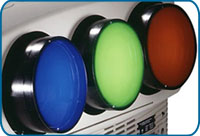
Not to bust your bubble ( or break your mirror ) but isn't it just easier to measure the distance from the red lens to the screen then the distance from the blue lens to the screen and make sure they are the same?
_________________
Tech support for nothing
CRT.
HD done right!
|
|
| Back to top |
|
|
Gino

Joined: 22 Apr 2006
Posts: 1363
Location: Trinity Beach, AUSTRALIA
|
| Posted: Tue Jun 02, 2009 5:23 am Post subject: |
|
|
AR - that method has faults. What if your projector was slightly rotated, but slightly off centre in the direction of the rotation? You could still measure equal distances.
_________________
( B ) ( G ) ( R ) Blendzilla Down Under ( R ) ( G ) ( B ) - Tubes of Fury
|
|
| Back to top |
|
|
ecrabb
Forum Moderator

Joined: 13 Mar 2006
Posts: 15909
Location: Utah
TV/Projector: JVC RS40, Epson 5010
|
| Posted: Tue Jun 02, 2009 6:18 am Post subject: |
|
|
Gino's right. You can't just check the two lenses for the reason he stated. You'd have to also measure to the back corners of the chassis to catch the rotation.
The mirrors thing... One with a hole, attaching it plumb and square, looking through the hole, and hoping you don't have any error anywhere... Sounds like a lot of dicking around with a lot of potential for error.
I still say the spinning laser is the easiest if you have one. If you set it up right, it strikes a line through screen center, across the ceiling, through the center of the green tube, and right down the center-line of the projector chassis. Bada bing! Takes about 15 minutes to set up right, and it's extremely accurate.
SC
|
|
| Back to top |
|
|
jask

Joined: 17 Mar 2006
Posts: 10187
Location: kamloops BC
|
| Posted: Tue Jun 02, 2009 7:59 am Post subject: |
|
|
| ecrabb wrote: | Gino's right. You can't just check the two lenses for the reason he stated. You'd have to also measure to the back corners of the chassis to catch the rotation.
The mirrors thing... One with a hole, attaching it plumb and square, looking through the hole, and hoping you don't have any error anywhere... Sounds like a lot of dicking around with a lot of potential for error.
I still say the spinning laser is the easiest if you have one. If you set it up right, it strikes a line through screen center, across the ceiling, through the center of the green tube, and right down the center-line of the projector chassis. Bada bing! Takes about 15 minutes to set up right, and it's extremely accurate.
SC |
I am not sure how much good that would be, the screen could still be off of perpendicular to that axis...
|
|
| Back to top |
|
|
Tom.W

Joined: 09 Mar 2006
Posts: 6635
|
| Posted: Tue Jun 02, 2009 8:41 am Post subject: |
|
|
Quote:
I still say the spinning laser is the easiest if you have one. If you set it up right, it strikes a line through screen center, across the ceiling, through the center of the green tube, and right down the center-line of the projector chassis. Bada bing! Takes about 15 minutes to set up right, and it's extremely accurate.
Can you elaborate on what method you use to align the spinning laser to the projection path of the projector ?
|
|
| Back to top |
|
|
garyfritz

Joined: 08 Apr 2006
Posts: 12088
Location: Fort Collins, CO
|
|
| Back to top |
|
|
ecrabb
Forum Moderator
Joined: 13 Mar 2006
Posts: 15909
Location: Utah
TV/Projector: JVC RS40, Epson 5010
|
| Posted: Tue Jun 02, 2009 3:30 pm Post subject: |
|
|
| jask wrote: | | I am not sure how much good that would be, the screen could still be off of perpendicular to that axis... |
That's why you find perpendicular before you fire up the laser. I neglected to mention that part.
| Tom.W wrote: | | Can you elaborate on what method you use to align the spinning laser to the projection path of the projector ? |
Yep. I'll quote myself from an older post so I don't have to describe it from scratch...
| ecrabb wrote: | Find the center of the screen and translate that to the ceiling at the wall/ceiling intersection point (use a spirit level or the laser level). Then, using a tape measure and the 3/4/5 method (or a little basic trig) and a mechanical pencil (you can use painter's tape if you don't want to make marks on the ceiling), find a point on the ceiling - say 8' from the screen. On the screen you have screen center marked at top and bottom (and center, too - you'll need to do geometry, anyway).
Then, set up a laser level on a tripod close to the projector, but well in front of it, a meter or 1.5 off the floor. In "plumb" mode (vertical orientation), you can then strike a laser line right up screen-center, across the ceiling through both marks, and across the projector chassis. The laser line will then be the perfectly orthogonal projection. If the projector is mounted square and centered, the laser line will strike right through the center of the green lens (or tube face), right across the center of the chassis, and will land right between two metal tabs on the remote IR sensor at the back of the chassis. Any error in mounting of more than a few mm will be immediately obvious, as will <1 degree of rotation.
I have my projector square and centered down to within a few millimeters using that method. |
The "two metal tabs on the remote IR sensor at the back of the chassis" remark referred to a 1271, but I assume practically every other chassis have a spot on their fore and aft that would be easy to locate center-line.
SC
|
|
| Back to top |
|
|
|
|
|
|
|
You cannot post new topics in this forum
You cannot reply to topics in this forum
You cannot edit your posts in this forum
You cannot delete your posts in this forum
You cannot vote in polls in this forum
You cannot attach files in this forum
You can download files in this forum
|
Forum powered by phpBB © phpBB Group
|
|