|
As this forum is rarely used anymore, we've locked it. Feel free to browse and read. Questions? Please reach out to us directly. Cheers! |

|
 |
|
|
| Author |
Message |
jp25
Joined: 26 Apr 2025
Posts: 10
Location: Toronto, Canada
|
| Posted: Sat May 24, 2025 2:59 pm Post subject: |
|
|
| kal wrote: | | km987654 wrote: | | I don't think this thread is about what digitals can do but rather where CRTs are better as well as why those of us still using a CRT projector are doing so .... This is also not a thread for the reason why anyone switched either. |
But it is why people switch, indirectly. People switched because the list of things that CRTs are better at has gotten smaller and smaller as time goes on, or the gap has lessened. It's directly related.
For example, I mentioned previously above that image quality for me was paramount over size/weight/cost/etc, so I started with CRT. Eventually digital passed CRT in terms of overall image quality so I switched, as did most people. There are exactly zero CRT projector manufacturers left for this reason. Some will argue it's because CRT is expensive to make which is true, but that's not why they're gone. There always niche markets for all high end products from fridges to cars to projectors. There are certainly enough extreme HT enthusiasts out there who will pay anything for the best image quality so a small niche of projector manufacturers to look after these people do exist, but none of the manufacturers are using CRT.
One example of such a projector is the Christie Eclipse which costs $350K and weighs 346 lbs for the projector head plus another 330 lbs for the RGB 3-laser unit which lights up 6 DLP (DLP? Yes) panel. More discussion here: https://www.avsforum.com/threads/christie-eclipse-projector-world%E2%80%99s-best-home-theater-projector.3155910/
Well known HT enthusiasts like Art Sonneborn own one and he certainly lives in the "image quality is king" camp and has deep pockets. He started with a stacked setup of two NEC PG series CRT projectors but now owns one of these.
More down to earth on the consumer front we have JVC and Sony who all produce high end projectors - none of which use CRT but ironically they do use a form of phosphor lit by laser. Want CRT like image quality? This is a good place to start. I run a JVC NZ7 myself which has JVC's third-generation BLU-Escent module with a blue laser diode array and yellow phosphor wheel to generate the red, green, and blue signals for the native 4K, 0.69-inch D-ILA imagers. Not the same as the phosphor we're used to however as the colour gamut is much wider than what we had with CRT.
| jp25 wrote: | | My personal opinion is that part of the appeal of CRT is the full spectrum of colours, reaching the edges of visible light—and getting into UV territory and on the verge of near-infrared. |
Funny enough, CRT projectors have a much more limited range of colours than newer technology available today.
When CRT phosphor response was created (invented) many years ago it was done to meet the existing technology available at the time which was SDTV (Rec.601 gamut). Then HDTV (Rec.709 gamut) came along and it's extremely close to Rec.601.
CRT requires some colour filtering to get to Rec.601/Rec.709. Most better units are equipped with color corrected (filtered) red and green CRTs which achieve rec. 709 (HD) color coordinates, or they come very close. See this thread: https://www.curtpalme.com/forum_archived/viewtopic.php@t=5604.html
A well calibrated CRT projector should be able to reach to Rec.601 (SDTV) and Rec.709 (HDTV). In some cases colour filters are required or clear c-elements need to be replaced with tinted c-element (same result). You reduce light output of course when doing this. This is required because most CRT projectors were originally manufactured with clear glycol or clear red and green c-elements in order to increase the overall light output of the projector as the original use for many of these projectors was not for home theater. Those people wanted light output, not colour accuracy.
Now fast forward to today and we have UHD (Rec.2020) gamut and HDR-TV (Rec.2100) which are considerably larger gamuts and beyond the capacity of what CRT phosphors can deliver:
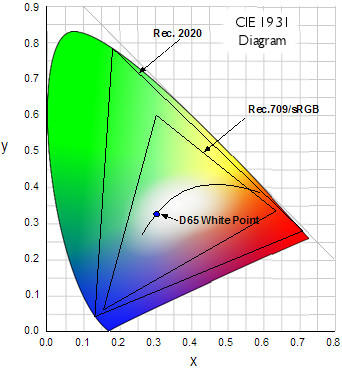
You can't get a CRT projector to do Rec.2020 / 2100 colour gamut. I just won't happen. The phosphors simply cannot resolve those colours no matter what you do. You need to map that Rec.2020 space back to Rec.709. Newer digitals however can do Rec.2020 / 2100.
Rec.709 (what CRT can do) covers 35.9% of the visible spectrum while Rec.2020 (what newer digitals can do) covers 75.8%.
Kal |
Thank you for sharing that, you made me go do a deeper look into this topic.
All of what you've written makes sense. And you are correct that the new colour gamuts are more precise, and with tighter blues and greens and reds, you could make more precise colours (or the illusions of more colours.)
I was trying to understand how you can make purple on a display, which is a faster wavelength than blue, when there's no purple gun.
https://www.youtube.com/watch?v=iPPYGJjKVco
It seems like RGB light from displays is just tricking our eyes to see colours. It's not actually yellow at 580nm—it's green and red mixed.
It's not actually purple at 420nm; it's blue light and red light mixed, tricking our eyes into seeing a colour that's not actually there.
I think this could explain one piece of the magic of CRT.
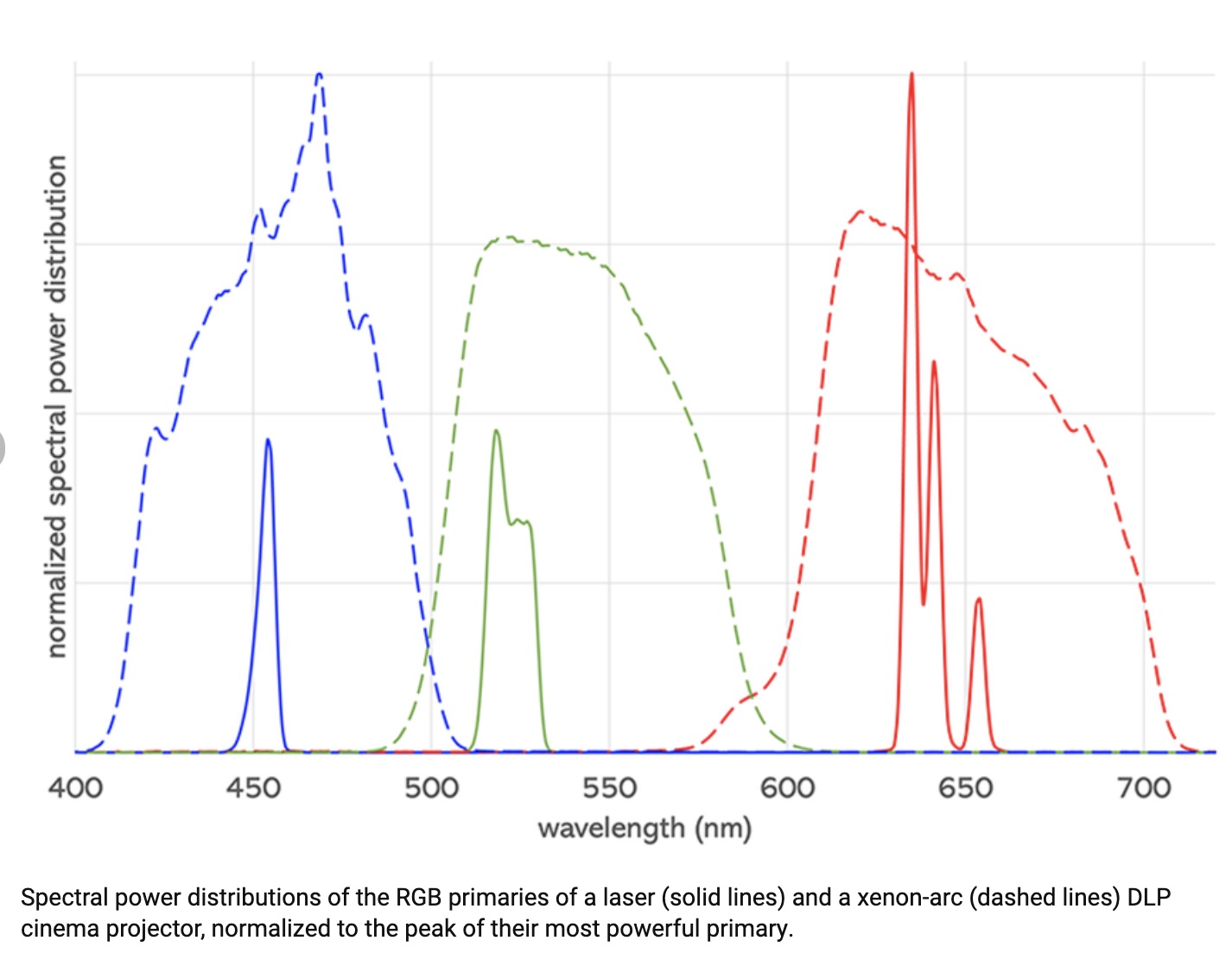
The blue gun isn't precise like a laser, where it's a tight 450nm. It has a fuller spectrum—drifting all the way into 380 (ultraviolet!) on the blue gun. And the red gun reaches all the way to 725nm, or right to the cusp of near-infrared. (You can almost feel the heat of the flame flickering on the projector screen.)
Our naked eyes can see UV, and that may give the appearance of realism, even if the colour accuracy is less precise. Perhaps this is not unlike audio tube amplifiers. They "color" the sound, and are less accurate, but give more pleasing harmonics, as it more closely matches real life.
Just my two cents and some conjecture while trying to understand the fun of CRTs.
| Description: |
| Laser Wavelength Is More Precise |
|
| Filesize: |
151.58 KB |
| Viewed: |
190 Time(s) |
|
| Description: |
| Wavelength vs blended light |
|

Download |
| Filename: |
rgb-light-tricks-eyes-not-real-wavelength.jpg |
| Filesize: |
466.9 KB |
| Downloaded: |
7 Time(s) |
|
|
| Back to top |
|
 |
kal
Forum Administrator
Joined: 06 Mar 2006
Posts: 18114
Location: Ottawa, Canada
TV/Projector: JVC DLA-NZ7
|
| Posted: Sat May 24, 2025 4:52 pm Post subject: |
|
|
| jp25 wrote: | | And you are correct that the new colour gamuts are more precise, and with tighter blues and greens and reds, you could make more precise colours (or the illusions of more colours.) |
They're not more precise, the gamut of colours that can be created is wider.
| jp25 wrote: | I was trying to understand how you can make purple on a display, which is a faster wavelength than blue, when there's no purple gun.
https://www.youtube.com/watch?v=iPPYGJjKVco
It seems like RGB light from displays is just tricking our eyes to see colours. It's not actually yellow at 580nm—it's green and red mixed.
It's not actually purple at 420nm; it's blue light and red light mixed, tricking our eyes into seeing a colour that's not actually there.
I think this could explain one piece of the magic of CRT. |
That's not unique to CRT. Most other projector display technologies (DILA, LCD, DLP, OLED) also produce 3 primary colours (RGB) and mix them.
Kal
_________________

Support our site by using our affiliate links. We thank you!
My basement/HT/bar/brewery build 2.0
|
|
| Back to top |
|
|
jp25
Joined: 26 Apr 2025
Posts: 10
Location: Toronto, Canada
|
| Posted: Sat May 24, 2025 5:37 pm Post subject: |
|
|
| kal wrote: | | jp25 wrote: | | And you are correct that the new colour gamuts are more precise, and with tighter blues and greens and reds, you could make more precise colours (or the illusions of more colours.) |
They're not more precise, the gamut of colours that can be created is wider.
| jp25 wrote: | I was trying to understand how you can make purple on a display, which is a faster wavelength than blue, when there's no purple gun.
https://www.youtube.com/watch?v=iPPYGJjKVco
It seems like RGB light from displays is just tricking our eyes to see colours. It's not actually yellow at 580nm—it's green and red mixed.
It's not actually purple at 420nm; it's blue light and red light mixed, tricking our eyes into seeing a colour that's not actually there.
I think this could explain one piece of the magic of CRT. |
That's not unique to CRT. Most other projector display technologies (DILA, LCD, DLP, OLED) also produce 3 primary colours (RGB) and mix them.
Kal |
Yes, you're right that RGB is not limited to CRTs.
But CRTs are the only ones generating ultraviolet and near-infrared radiation, as far as I know of. The spectrum of actual wavelength frequencies goes wider. What if those wavelengths are contributing to the real life effect? (It seems it might even go beyond trace UV-C, as CRT boxes have X-ray warnings on them?)
|
|
| Back to top |
|
|
kal
Forum Administrator
Joined: 06 Mar 2006
Posts: 18114
Location: Ottawa, Canada
TV/Projector: JVC DLA-NZ7
|
| Posted: Sat May 24, 2025 7:49 pm Post subject: |
|
|
| jp25 wrote: | | What if those wavelengths are contributing to the real life effect? |
Calibration meters can't measure them, our eyes can't see them, so what does it matter?
What calibration meters and our eyes can see is that CRT isn't able to produce as wide of a colour gamut as newer displays including Rec 2020. That's really all that matters in terms of wavelengths and picture quality.
Kal
_________________
Support our site by using our affiliate links. We thank you!
My basement/HT/bar/brewery build 2.0
|
|
| Back to top |
|
|
Curt Palme
CRT Tech
Joined: 08 Mar 2006
Posts: 24396
Location: Langley, BC
TV/Projector: All of them!
|
| Posted: Wed Jun 18, 2025 7:07 pm Post subject: |
|
|
At this point, CRT projectors are unsurpassed with the low mean time between failures. 
|
|
| Back to top |
|
|
kal
Forum Administrator
Joined: 06 Mar 2006
Posts: 18114
Location: Ottawa, Canada
TV/Projector: JVC DLA-NZ7
|
| Posted: Thu Jun 19, 2025 12:17 pm Post subject: |
|
|
| Curt Palme wrote: | | At this point, *new* CRT projectors are unsurpassed with the low mean time between failures. |
Fixed that for you.  In all seriousness, these days any CRT projector is getting so old that the MTBF isn't going to be what it was when it was new. The newer the model, the better your chances of course. In all seriousness, these days any CRT projector is getting so old that the MTBF isn't going to be what it was when it was new. The newer the model, the better your chances of course.
How new is the newest CRT projector these days? I think some Marquee's were sold in the early 2000s?
Barco also had their "CRT forever" campaign in 2003 which I believe featured a Cine 9. That ran for a few years.
So about 20 years old is the newest?
Kal
_________________
Support our site by using our affiliate links. We thank you!
My basement/HT/bar/brewery build 2.0
|
|
| Back to top |
|
|
Curt Palme
CRT Tech
Joined: 08 Mar 2006
Posts: 24396
Location: Langley, BC
TV/Projector: All of them!
|
| Posted: Thu Jun 19, 2025 3:05 pm Post subject: |
|
|
|
I know someone posted a pix of the last 6 or 12 Marquees made somewhere in this group. It may have been 20 years ago, maybe 15?
|
|
| Back to top |
|
|
Tim in Phoenix

Joined: 21 Oct 2006
Posts: 4409
Location: Phoenix
|
| Posted: Fri Jun 20, 2025 5:05 pm Post subject: |
|
|
Say Curt
Likely 2012 or so
|
|
| Back to top |
|
|
Videodrome

Joined: 22 Feb 2023
Posts: 56
|
| Posted: Sat Jul 12, 2025 10:56 am Post subject: |
|
|
Motion.
CRT's are simply the best at mimicking reality.
Whenever you project a 3D environment, like most games, you can focus your eyes anywhere on the screen during motion without fatigue.
So when you rotate the camera and see an object, you can follow that object while moving the camera without losing any sharpness.
On any other type of technology, it'll be slightly blurry when moving and sharp when you stand still. This might not seem 'big', but it is.
The constant switch between blur and sharp becomes tiresome. Most people defocus or blink during those moments to compensate.
The play with parallax distances on a CRT, everyone can remember sitting in the passenger seat or train while things go by, you can focus on different distances, while the others become a perfect motion blur. Even the railing close-by, you could do it for an instant, but it would be sharp. This 'game' can be played on a CRT without effort, while any other screen this is simply not feasable, because you're trying to focus on something that blurry. Even non-3d, old strategy games like C&C, Starcraft and such, the scrolling of the map is so much better on a CRT.
I recently got a 2nd hand CHRISTIE 3DLP, fantastic machine and at 120Hz very impressive, just not quite there.
I'll probably upgrade to a 480Hz laser Christie in the future, hoping it can mimic reality like CRT's can.
|
|
| Back to top |
|
|
|
|
|
|
|
You cannot post new topics in this forum
You cannot reply to topics in this forum
You cannot edit your posts in this forum
You cannot delete your posts in this forum
You cannot vote in polls in this forum
You cannot attach files in this forum
You can download files in this forum
|
Forum powered by phpBB © phpBB Group
|
|