| Author |
Message |
KrisRoberts
Joined: 21 Jan 2007
Posts: 115
Location: San Diego
|
| Posted: Tue Feb 02, 2010 7:49 pm Post subject: G90 & 3D Vision - P19LUG Green Phosphor Decay Time? |
|
|
I have been experimenting with my G90 as well as a few desktop CRT monitors and the Nvidia 3D Vision shutterglasses.
After some initial grief getting Windows 7 and the 3D Vision drivers to work at proper resolution and frame rates I’ve found that all the displays have significant ghosting issues. None of them are quite the same, they either ghost at the top or bottom of the screen. The characteristics of each do not change very much at different refresh rates or resolutions.
On the G90 the ghosting is in the bottom 1/3rd of the image. Basically each eye sees both images in that portion of the screen and it destroys the 3D illusion.
There are no adjustments available in the 3D Vision software either in their UI or registry to adjust phase or sync timing. Many people with various displays (digital fixed panels and dlp sets) are also reporting similar ghosting issues. There is some mention in their forums about previous drivers having some values exposed but I have not been able to find them or get clarification of which versions were supposed to support what level of adjustment.
I do believe that if the phase was adjustable the ghosting could be improved, but perhaps not eliminated altogether.
We’ll see if they respond to what seems like a loud and clear request from their user community to allow individual tweaks. Its sad because in the day the Nvidia 3D Stereo Drivers used to be very open and flexible, supporting a wide range of configurations and solutions. But for the last few years they have increasingly closed their solutions and focused on supporting specific vendors and now even with officially supported sets they don’t seem to be responding well to the community reporting issues.
In any event my question for you guys is whether anyone has data on what the decay time is for the green P19LUG?
I'd like to know if just looking at the math whether there is a reasonable window for the decay vs frame rate to work between the supported 85Hz - 140Hz refresh rates.
With the G90 its easiest to switch the individual tubes off and look at them separately. And indeed the red and blue do show some of the ghosting, but it is much more of a problem on green. But what seems weird to me is that I see no significant difference in the area of the green image that ghosts at 85Hz vs 120Hz. If the green decay time was indeed the root of the problem I would expect a proportional increase in the screen area that shows the ghosting as the frame rate is increased.
|
|
| Back to top |
|
 |
tse
Joined: 03 May 2006
Posts: 1014
Location: Sweatbucket, Fl.
|
| Posted: Wed Feb 03, 2010 12:43 am Post subject: |
|
|
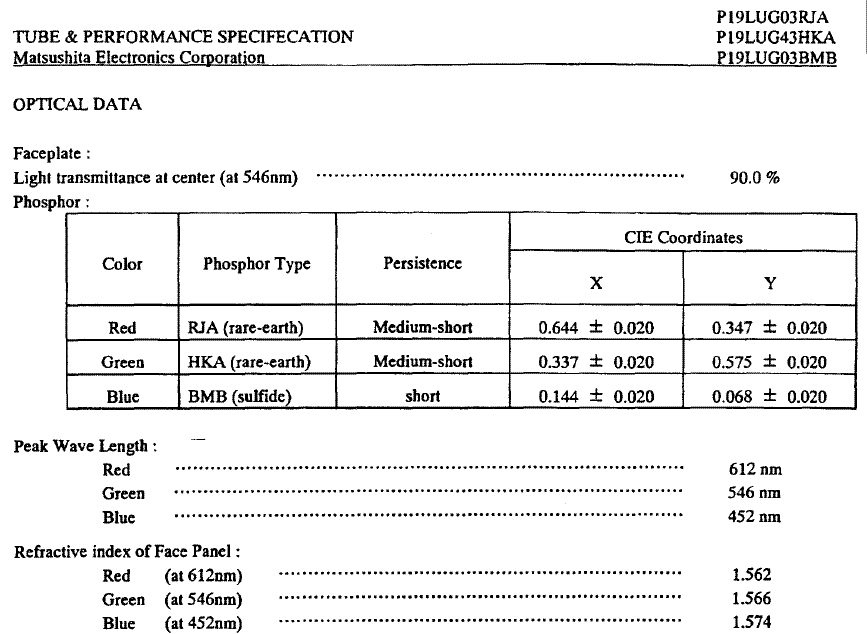
The persistance of the blue phosphor is very short. The ghosting problems should be much less with blue if persistance is the problem.
Scott
| Description: |
|
| Filesize: |
26.38 KB |
| Viewed: |
15089 Time(s) |
|
_________________
"Were we directed from Washington when to sow and when to reap, we would soon want bread."
Thomas Jefferson
|
|
| Back to top |
|
|
zGman
Joined: 22 May 2006
Posts: 599
|
| Posted: Wed Feb 03, 2010 4:35 am Post subject: |
|
|
It seems odd that there is ghosting on just part of the tubeface - if it was
due to phosphor persistance I would expect the entire tubeface should be
involved. I wonder if this is possibly a video chain (vnb, input amp, etc)
issue - or even as you suggest, a fluke in the software...
|
|
| Back to top |
|
|
Francis Vaughan
Joined: 28 Jul 2009
Posts: 12
|
| Posted: Wed Feb 03, 2010 5:15 am Post subject: |
|
|
One would assume that the ghosting is simply due to the fact that the top 2/3rds of the screen has had enough time to decay to the point where there was not enough residual luminance for a visible ghost to occur. But indeed, as the frame rate increases, the proportion of screen ghosting should increase. The decay is probably exponential, but not all phosphors are. There is all sorts of wierd stuff going on inside them. The dwell time on the glasses may be a factor as well, as they won't switch instantly, so the amount of time between alternate frames may be more constant than the frame rate suggests. Indeed that might be enough to explain the constant height of ghost.
Years ago I had a Barco 808s with fast green phosphor setup for a VR lab. Barco were quite adamant that you needed the fast phosphors. The 3D was implemented with CrystalEyes shutter glasses, and when the glasses were working (they were notoriously fragile) the illusion was very good.
I have been chasing down phosphor charateristics for a week odd now. What I do find is that although there are standard phospor designations, the precise charateristics is subject to the whim of the individual manufacturer. So far as I can see, the reason a fast (i.e P43) phospor isn't used for most projectors is that it is slighly more yellow. This comes from a couple of spikes in the emmision spectra at about 590 and 620 nm, rather than the peak emmision being shifted to longer wavelengths. The usual green is a much wider spread of wavelengths than P43, but no peaks in the red.
|
|
| Back to top |
|
|
Nashou66

Joined: 12 Jan 2007
Posts: 16171
Location: West Seneca NY
|
|
| Back to top |
|
|
ecrabb
Forum Moderator

Joined: 13 Mar 2006
Posts: 15909
Location: Utah
TV/Projector: JVC RS40, Epson 5010
|
| Posted: Wed Feb 03, 2010 8:59 am Post subject: |
|
|
Kris, what you're describing really sounds like a glasses sync/timing issue rather than a phosphor decay issue. As zGman point out, phosphor decay should result in global ghosting across the frame. You will have some phosphor decay ghosting, but it shouldn't "destroy the 3D illusion" completely.
Sounds like Nvidia needs to get their crap together.
SC
|
|
| Back to top |
|
|
roland@b4

Joined: 07 Jul 2009
Posts: 82
Location: Reading UK
|
| Posted: Wed Feb 03, 2010 9:21 am Post subject: |
|
|
From my limited experience with P43 tubes. The major problem in the home cinema environment is getting a good grey scale because the faster phosphor was not reacting the same as the other tubes on the gamma curve.
One test to see if its the tube causing the ghost is to cut the light output by reducing the brightness and contrast a bit. On the premise that if you are exciting the phosphor less it won't glow for as long.
I do recall using a standard 1609QDTV for an HD 3D demo at 100hz about 12 years ago and even on some sports material there was no ghosting.
|
|
| Back to top |
|
|
zGman
Joined: 22 May 2006
Posts: 599
|
| Posted: Wed Feb 03, 2010 2:00 pm Post subject: |
|
|
I have a couple P43 909 sim tubes here - and have tested one back to back
with a normal LUG. There is less light output, and the color is definitely pushed
toward yellow. In the wiki article on phosphors P43 is listed as "green-yellow"
and there is a note that the efficiency drops off rapidly with incresing temp.
I am planning to build build a "gaming" rig with these tubes that will run 72 or
90 hz in a 1209S chassis. It will use a fairly small curved screen, so the light
output shouldn't be a big issue. Thanks guys for the info on the 3D devices,
it sounds like there's some fun to be had once the bugs are ironed out.
http://en.wikipedia.org/wiki/Phosphor
|
|
| Back to top |
|
|
CIR Engineering

Joined: 25 Aug 2008
Posts: 4269
Location: Chicago USA & Berlin Germany
|
| Posted: Wed Feb 03, 2010 3:33 pm Post subject: |
|
|
I think the timing is off between the glasses and the video and that is what is causing the ghosting. I have had lots of trouble with lip sync on CRT projectors and this may be the same sort of thing...
I see on CRT projectors that frequently the video gets ahead of the audio. In most digital home theaters it is the opposite, the audio gets ahead of the video. Most BD players and audio processors have lip sync delay to slow down the audio some to time it properly with the video again.
On digital projectors there is always video lag / delay and the image is retained in the projector for some time before it is on screen. It seems that with respect to audio, manufacturers assume that there will be some delay in the video chain that will slow the video down with respect to the audio. With CRT there is practically no lag, so if audio delay is built into the BD disc, there is no way to retime it properly because there is no way to delay the video.
I wonder if this could be the case for the Nvidia regarding 3D as well?
craigr
_________________
JETI 1501-HiRes 2nm Spectroradiometer
JETI 1211 Spectroradiometer
Photo Research PR-650 Spectroradiometer
Klein K10-A Colorimeter
Murideo Fresco SIX-G HDMI 2.x Multimedia Generator
Murideo Fresco SIX-A HDMI 2.x Analyzer
Light Illusion ColourSpace XPT Color Calibration Software
Light Illusion LightSpace XPT Pro Version 10.x Color Calibration Software
OMARDRIS JVC Software Patch to use K10-A and Jeti with JVC OEM AutoCal Software!
Sencore CR7000 CRT Tube Analyzer / Rejuvenater
Authorized Dealer for Lumagen & just about everything worth buying 
www.CIR-Engineering.com - craigr@cir-engineering.com
Phone: 865-405-6892
|
|
| Back to top |
|
|
Francis Vaughan
Joined: 28 Jul 2009
Posts: 12
|
| Posted: Wed Feb 03, 2010 5:49 pm Post subject: |
|
|
My impression looking at the P43 spectra is that with the addition of a well chosen filter the colour could be, if anything, superiour to a standard phosphor. But without, the additional red content will make it quite yellow in comparison. The lower light output is interesting, but not too surpring. The P43 has a very narrow, but intense, band at about 545nm, of only about 10nm width. In comparison, the ordinary phosphors are much wider, if less intense at any given wavelength. I have been hunting around for suitable filters. The perfect filter would appear to be a Lee dichroic filter, http://www.leefilters.com/lighting/products/finder/act:colourdetails/colourRef:C4630710CCFA5B/. It will slice off the red output with essentially no change in green output. I would imagine it would end up with about the same light output as a filtered normal green phosphor and with much the same (improved) colour.
Back to the OP's question. I think everything points to a timing issue. Ghosting at the top of the screen is clearly this, and cannot be explained by persitence of the phosphor. Even when working well, the LCD shutter glasses are not 100% efficient, and they have some bleed. We found in the VR system that on wire frame, and other graphics with strong thin bright lines, that there was a noticable, although not intrusive, cross eye bleed. On images that were more realistic, bleed was not noticable. I suspect that with a slower green phosphor we would have had significant issues with things like wire frame graphics, and this may have been part of the strong recommendation towards a fast phospor.
|
|
| Back to top |
|
|
CIR Engineering
Joined: 25 Aug 2008
Posts: 4269
Location: Chicago USA & Berlin Germany
|
| Posted: Wed Feb 03, 2010 6:55 pm Post subject: |
|
|
There are often unforeseen optical issues when you add a filter.
With a 9" projector, the ideal would be to create color corrected c element for the p43 phosphor. However, C elements are very precise pieces of optics and are difficult to manufacture. An off the shelf Lee is worth a shot, but...
craigr
_________________
JETI 1501-HiRes 2nm Spectroradiometer
JETI 1211 Spectroradiometer
Photo Research PR-650 Spectroradiometer
Klein K10-A Colorimeter
Murideo Fresco SIX-G HDMI 2.x Multimedia Generator
Murideo Fresco SIX-A HDMI 2.x Analyzer
Light Illusion ColourSpace XPT Color Calibration Software
Light Illusion LightSpace XPT Pro Version 10.x Color Calibration Software
OMARDRIS JVC Software Patch to use K10-A and Jeti with JVC OEM AutoCal Software!
Sencore CR7000 CRT Tube Analyzer / Rejuvenater
Authorized Dealer for Lumagen & just about everything worth buying
www.CIR-Engineering.com - craigr@cir-engineering.com
Phone: 865-405-6892
|
|
| Back to top |
|
|
zGman
Joined: 22 May 2006
Posts: 599
|
| Posted: Wed Feb 03, 2010 8:53 pm Post subject: |
|
|
I plan to use a standard green c-element with the P43 tube and
will post the results - maybe by the end of Feb with some luck...
|
|
| Back to top |
|
|
Francis Vaughan
Joined: 28 Jul 2009
Posts: 12
|
| Posted: Thu Feb 04, 2010 3:33 am Post subject: |
|
|
I would be very interested in the results with a green c-element. The Lee filters turn out to be well, expensive. Especially here in Oz. I was hoping that since they were a lighting rather than a true optical quality component they would be cheap - but probably not cheap enough as it turns out. A set of 144s plus Joust adaptors could run me close enough to the cost of the filters to make the 144s the preferred option - if the spectra works out. Standard film lighting filters, either Lee or Roscoe might be worth trying - much cheaper to play with. But they all cut a significant amountof light - and for a P43 phosphor they might cut too much. (Which is what worries me about even a coloured C element. It is designed for normal phosphors, and the quite substantial iofferences in spectra might make them simply wrong.)
A filter will always add a pair of interfaces in the optical path - which can't ever be good. I was hoping to try them in front of the lens and angled enough that any surface reflections could be directed away from harm. Still thinking.
|
|
| Back to top |
|
|
zGman
Joined: 22 May 2006
Posts: 599
|
| Posted: Thu Feb 04, 2010 4:25 am Post subject: |
|
|
I think a few of us have tried the 'roscoe' plastic filters in AC
applications. They do improve the primaries, but reduce focus.
Colored glycol works quite well for AC applications, and I think
Curt was offering some free sony tubes to salvage the glycol.
Anything in the optical path without antireflective coatings
will cause ~3.8% loss at each interface (each time the
refractive index changes) So a normal sheet of window glass
loses about 8% total.
The filters in the HD144 or 145 lenses are pretty good to get
correct primaries. The reds may be slightly oversaturated,
but that is price of getting rid of the orange.
Same thing with the c-elements, the green filter takes out the yellow,
and the red filter takes out the orange.
In general, the c-elements are fairly broadband absorption type
filters, where the "dichroic" filters are multilayer thin film
filters that actually reflect/reject the unwanted frequencies.
I expect one large enough for a CRT wouild be pricey...!
|
|
| Back to top |
|
|
Francis Vaughan
Joined: 28 Jul 2009
Posts: 12
|
| Posted: Thu Feb 04, 2010 12:00 pm Post subject: |
|
|
Yeah, I was worried about the losses, but actually more worried about softening of the image. The huge advantage the dichroic filters have is their very low insertion loss in the passband. Even allowing for a loss of 8% with the interfaces, the dichroic filter transmission of 90% versus 60% for a medium green gel type filter makes it a huge win. I will assume the colourd c-elements have much the same loss as the gels filters, since both are essentially absorbance dyes. (I would expect that the interface losses are already factored into those numbers - so we should allow the c-element an 8% advantage. None the less, still a huge win for the dichroic.) One thing that I would like to chase down is the first surface losses of the dichroic filters. If they are naked interference films at the surface they will act in exactly the same manner as an antireflection coating. Softening of the image is the risk - but a glass filter should be better here anyway.
A 6.3" dichroic filter is $85 US (Roscoe) or $100 (Lee). That should easily cover the tube face on my 808s, and is larger than the main element of the HD-8s. So I'm leaning that way again. But I really want to hear how a coloured c-element works out.
All thought experiments at the moment. Since I'm very late into this game, finding affordable 144's (where affordable includes shipping to Oz) may prove a little hard. I'm really only interested in conventional movies at the moment. 3D is just something that could be fun, and since I can do it, why not?
|
|
| Back to top |
|
|
CIR Engineering
Joined: 25 Aug 2008
Posts: 4269
Location: Chicago USA & Berlin Germany
|
| Posted: Thu Feb 04, 2010 2:20 pm Post subject: |
|
|
| zGman wrote: | ...The reds may be slightly oversaturated,
but that is price of getting rid of the orange. |
Actually, the red c element doesn't make the red oversaturated anymore than it is with a clear. The red c element moves the primary away from green and towards red bringing it closer to REC709.
I did some experimentation the other week: http://www.cir-engineering.com/red_celement_compare.php
craigr
_________________
JETI 1501-HiRes 2nm Spectroradiometer
JETI 1211 Spectroradiometer
Photo Research PR-650 Spectroradiometer
Klein K10-A Colorimeter
Murideo Fresco SIX-G HDMI 2.x Multimedia Generator
Murideo Fresco SIX-A HDMI 2.x Analyzer
Light Illusion ColourSpace XPT Color Calibration Software
Light Illusion LightSpace XPT Pro Version 10.x Color Calibration Software
OMARDRIS JVC Software Patch to use K10-A and Jeti with JVC OEM AutoCal Software!
Sencore CR7000 CRT Tube Analyzer / Rejuvenater
Authorized Dealer for Lumagen & just about everything worth buying
www.CIR-Engineering.com - craigr@cir-engineering.com
Phone: 865-405-6892
|
|
| Back to top |
|
|
zGman
Joined: 22 May 2006
Posts: 599
|
| Posted: Thu Feb 04, 2010 6:00 pm Post subject: |
|
|
Ok - seems like you are quite knowledgeable about optics, but I
haven't observed such a large loss using the gel filters, (or c-elements)
even accounting for the loss of the unwanted yellow. You need
to boost the tube output slightly, but not 40%.
Sounds like you have the BG808S with sony tubes. This is
considered an Air Coupled design, and does not use a "c-element"
as you are likely aware.
Although its a bit of work to remove the tube and exchange the
glycol, the colored glycol from sony tubes is pretty well engineered
to hit the primaries spot on.
What sort of engineering were you doing with the bg808s 3D system?
|
|
| Back to top |
|
|
zGman
Joined: 22 May 2006
Posts: 599
|
| Posted: Thu Feb 04, 2010 6:07 pm Post subject: |
|
|
Hi Craig - nice test...
One way to better see the result of the filtered elements is to do a spectral response graph,
On the red you will see the peaks up in the orange range, which are reduced with the
filtered c-element. The filters can not add color, they can only subtract from what is there,
and there is precious little blue produced in the red phosphor.
There is a little green produced (which increases as the thube wears) in the blue phosphor,
but since the primary is already so close, and blue has to be driven so hard anyway (short
persistance), it is not worth filtering the blue.
G
|
|
| Back to top |
|
|
kschmit2
Joined: 09 Mar 2006
Posts: 1141
Location: Heidelberg, Germany
|
| Posted: Thu Feb 04, 2010 6:14 pm Post subject: Re: G90 & 3D Vision - P19LUG Green Phosphor Decay Time? |
|
|
| KrisRoberts wrote: |
In any event my question for you guys is whether anyone has data on what the decay time is for the green P19LUG?
I'd like to know if just looking at the math whether there is a reasonable window for the decay vs frame rate to work between the supported 85Hz - 140Hz refresh rates. |
Kris,
I don't know the numbers for green P19SPP tubes, but here are the numbers for green P16SPP tubes that should use the same phosphor:
1/10th persistence time: 2.6 micro seconds (standard green P16 has 4.8 micro seconds 1/10th persisitence time)
see attached document originally posted by Doug Baisey (btw, anyone know how he is doing atm?)
Kai
| Description: |
| NEC XG green P16 short persistence phosphor XGSPP-A & XGSPP-LC |
|

Download |
| Filename: |
Fast Phospor CRT.pdf |
| Filesize: |
131.85 KB |
| Downloaded: |
559 Time(s) |
|
|
| Back to top |
|
|
zGman
Joined: 22 May 2006
Posts: 599
|
| Posted: Thu Feb 04, 2010 6:18 pm Post subject: |
|
|
|
Nice find! Thanks..
|
|
| Back to top |
|
|
|
|